News
AI has a trust problem. So we're launching Sphinx 2.0.

Sphinx is the knowledge layer that makes your AI trustworthy
Date
05.26.2026
Author
Sphinx
AI has a trust problem. So we’re launching Sphinx 2.0.
AI technology has moved from science fiction to indispensable at a remarkable pace. Teams are asking AI for answers and companies are running AI on their data. Leaders are making decisions based on AI insights.
It should be transformative. It should be liberating. It should free teams to do what actually matters. But there's a big problem: What we've been hearing from teams, over and over again, is that they don't trust their AI.
That's why we're launching Sphinx 2.0.
We built Sphinx 1.0 as an agent to fix bad data. Working with enterprise teams showed us something bigger was needed. Organizations needed a knowledge layer. A place for institutional info. A system that every AI tool could rely on.
Sphinx 2.0 is that layer. It's the infrastructure that makes your AI trustworthy.
Teams don't trust their AI
Ask a leader about their AI tools right now, and what you'll hear is a different story than the one in the vendor demos.
"We spend as much time validating outputs as we do using them."
"I can't tell if the AI understood the question or just gave me an answer that sounds plausible."
"My three dashboards all have different numbers, and I have no idea which one is right."
"When something goes wrong, I can't trace why. There's no audit trail. I'm responsible for decisions I can't fully defend."
When it comes to analyzing data, AI outputs are wrong and no one can understand where they came from. Data is incorrect. AI hallucinates numbers. Teams can't trace how and why it came to conclusions, or what calculations were used.
The costs are high:
Time. Analysts spend days validating AI outputs
Money. Budget gets eaten by cleanup and rework
Rework. One bad insight cascades across the organization
Reputation. When numbers don't match, trust erodes
Teams that invested in AI hoping to move faster are bottlenecked by validation and correction. They're burning money on tokens and rework.
Why AI messes up
AI is smart, but it's not institution-smart. It's not an expert at your organization.
Your AI is impressive at pattern recognition. It can synthesize information, find correlations, and produce analysis that sounds completely authoritative. But understanding how your business actually operates is a different skill.
It doesn't know that "number of stores" means three different things across your organization. It doesn't know part of your database got corrupted last quarter and certain numbers have never been reliable since. It doesn't know your risk tolerance, which means that the same data pattern could be just noise to your business or a critical opportunity...with no way to tell the difference.
When you point an AI at this organizational chaos and tell it to analyze, it does what it's been trained to do: it predicts based on statistical patterns.
When those patterns don't exist in its training data, it doesn't say "I don't know." It fills the gap with something plausible and presents it with complete confidence.
An MIT study found something striking. When AI models are hallucinating, they're 34% more likely to use confident language than when they're actually correct. The worse the mistake, the more certain it sounds.
Gartner calls this the knowledge gap. We call it a billion-dollar vulnerability.
Why organizations can't solve this problem
Most teams try to solve this by doing one of two things:
Option 1: Lock it up upstream. Build a massive data dictionary and document everything perfectly. The problem is, the moment you document something, it becomes outdated. Your definitions evolve, your data changes, and you're constantly playing catch-up.
Option 2: Let it loose downstream. Give AI tools access to data and let them figure it out. Fast to implement, but potentially catastrophic results. Every team gets different answers. AI hallucinates. There's no audit trail and no way to trace reasoning back to its source. Teams waste weeks investigating where conclusions came from.
Neither approach works because they're treating the problem in the wrong place.
The knowledge layer, the institutional understanding of how your business actually uses data, belongs in the middle. It needs to be grounded in your real data, documented enough to be governed, and intelligent enough to evolve with your business.
That's the layer that was missing.
Meet Sphinx: The knowledge layer between your AI and your data
Sphinx sits between your AI and your data. Sphinx learns your institutional knowledge: how you define metrics, what business logic applies, what the quirks of your environment are. It becomes a living knowledge base that evolves with your organization.
When AI tools query your data, Sphinx validates them against your actual business logic. Assumptions get checked before they become conclusions. Hallucinations get caught. Every output is traceable back to source data with clear logic and reasoning.
Sphinx doesn't replace your AI tools. It gives them institutional knowledge and teaches them how your business actually works.
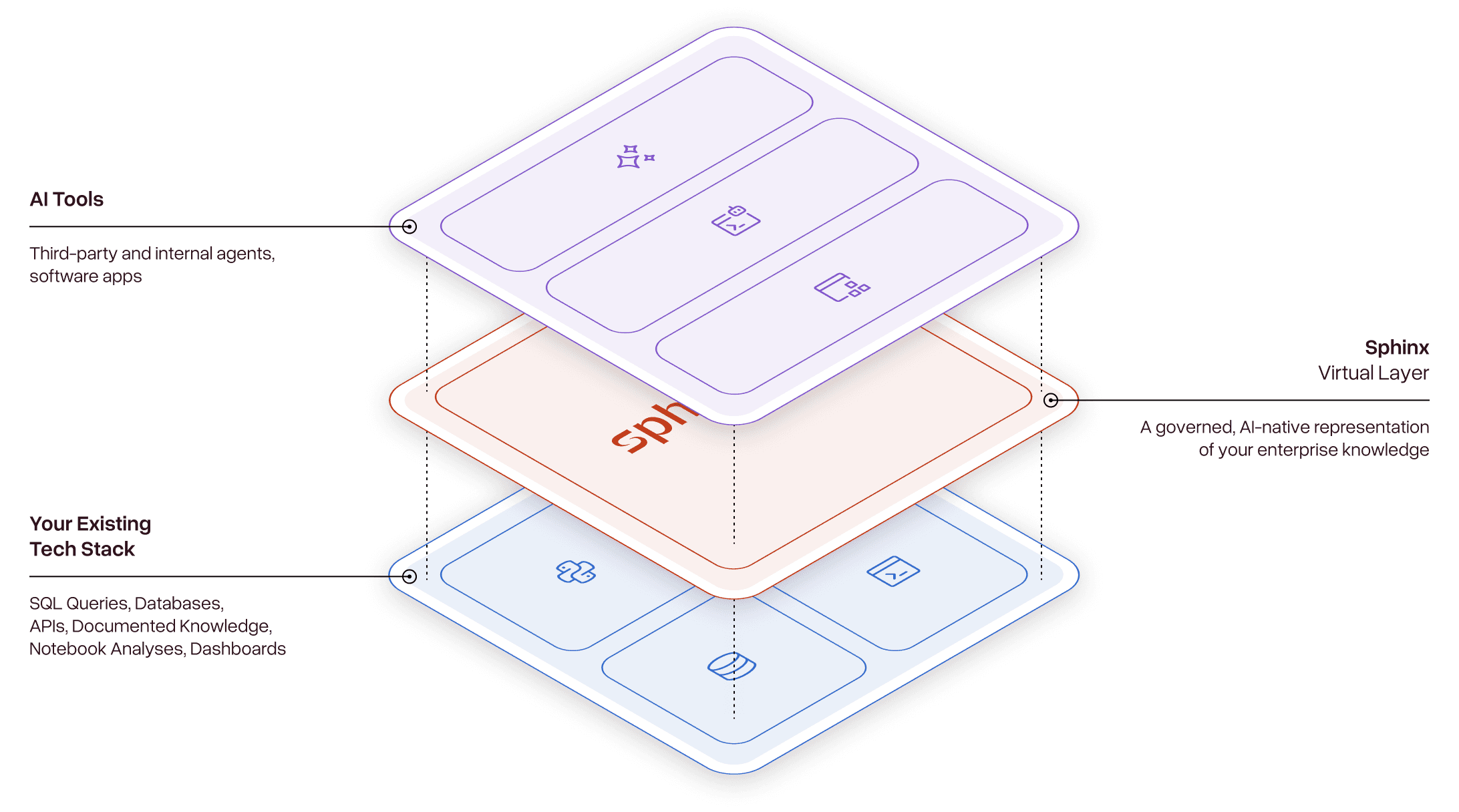
For your org, that means:
Your AI stops hallucinating because it understands context. Sphinx validates every query against your business logic and data rules, catching bad assumptions before they become conclusions.
Every output is traceable. The numbers your organization is relying on have already been verified by Sphinx. Your teams know exactly where they came from, what logic was applied, and how they would shift if the underlying assumptions changed.
Your team moves faster. When you remove the validation bottleneck and solve the "where do the numbers come from?" problem, your team becomes insanely efficient using AI.
You get control back. You decide exactly how much autonomy Sphinx has. Set it to validate and auto-correct where you need to move fast. Keep human approval gates where that matters more.
How it works
The elegance of Sphinx is that it lives on top of your existing stack:
1. Connects to your stack. Sphinx plugs into your databases, warehouses, and tools (Snowflake, BigQuery, Salesforce, whatever you're running).
2. Learns your knowledge. Sphinx infers institutional knowledge: how you define metrics, what your business logic is, what the quirks of your data environment are. This becomes a living, evolving knowledge base that automatically updates as your organization evolves.
3. Validates every query. When your AI tools ask your data questions, Sphinx checks the logic before any output goes anywhere.
4. Catches drift before it becomes a problem. Sphinx continuously detects inconsistencies, errors, and hallucinations. Then it fixes them.
5. Makes every output explainable. Every conclusion traces back to source data. Every step of logic is recorded. Every output is traceable. Full lineage + full auditability.
Trust your AI again
Early AI adoption was about raw intelligence; feeding smart models your data and seeing what they could do. That was revolutionary. It proved that AI could be genuinely useful.
Now organizations are waking up to the next level: AI needs to become an expert, not just intelligent.
Raw intelligence can find patterns. Institutional expertise knows what patterns matter.
Intelligence can run fast. Expertise runs right.
Intelligence is general. Expertise is specific to your business.
Sphinx brings both together.
Try Sphinx
See how Sphinx validates and maintains data accuracy across your entire organization.